
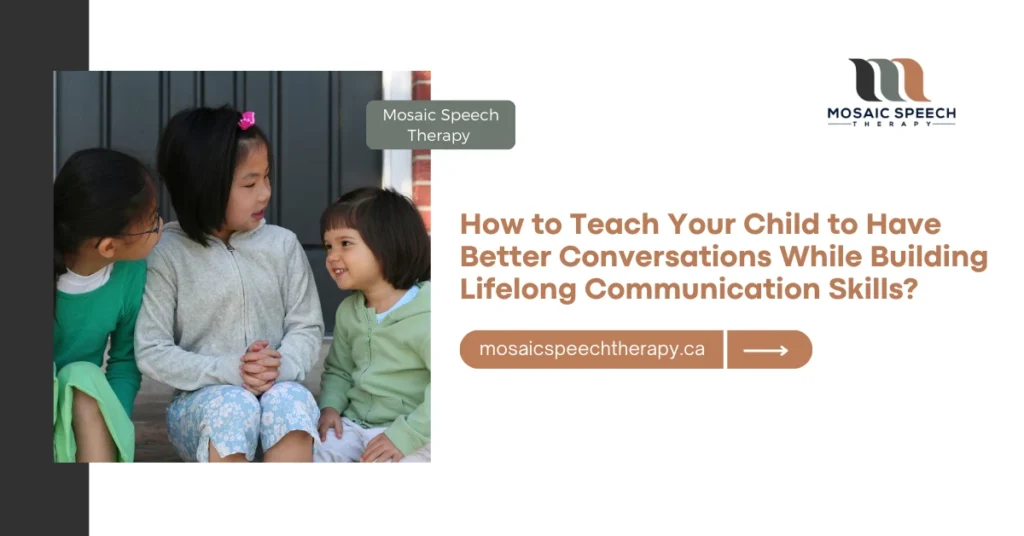
Many parents wonder how to teach your child to have better conversations without making it feel like a chore. The good news is that developing strong communication skills can be fun and natural when you know the right approach.
While some children might benefit from speech and language therapy to address specific challenges, most children can significantly improve their conversation abilities through consistent practice and guidance at home.
What Makes a “Good” Conversation?

A successful conversation involves much more than just talking. It requires listening, turn-taking, staying on topic, interpreting tone and facial expressions, and knowing how to begin and end an exchange appropriately.
These skills are often challenging for children with speech or language delays, social communication difficulties, or developmental differences like autism spectrum disorder.
Typical Conversation Development in Children
- Ages 2–3: Begin to use short phrases, respond to simple questions.
- Ages 3–4: Start engaging in brief back-and-forth exchanges.
- Ages 4–5: Ask questions, express ideas, stay on topic for several turns.
- School-age (5–10): Develop storytelling, understand social rules of conversation, adapt speech for the listener.
If your child falls significantly outside these benchmarks, targeted support may be helpful.
Step-by-Step Strategies to Teach Better Conversation Skills
1. Model Strong Conversational Habits at Home
Children learn by observing. Consistently model healthy dialogue in everyday life:
- Show active listening by nodding, making eye contact, and following up on their ideas.
- Narrate your thoughts aloud to demonstrate how we share ideas.
2. Practice Turn-Taking Through Play
Games like board games, Simon Says, and even pretend play encourage your child to wait, listen, and respond—critical skills in conversation.
- Prompt turn-taking during meals or shared activities.
- Use visual cues (e.g., a talking stick) to help them understand whose turn it is to speak.
- Practice call-and-response songs or rhymes to build rhythm and anticipation.
3. Ask Open-Ended Questions
Move beyond yes/no questions to foster fuller responses:
- Instead of “Did you have fun at school?”, ask “What was your favourite part of your day?”
- Give your child time to think. Don’t rush to fill the silence.
4. Teach Conversation Starters and Closers
Some children don’t know how to begin or end a chat. Scripted practice can help.
Teach starters like:
- “Hi, how are you?”
- “Can I ask you something?”
- “Guess what happened today?”
And closers like:
- “Thanks for talking with me.”
- “See you later!”
- “I have to go now, but I’ll tell you more next time.”
5. Encourage Topic Maintenance
Children often shift topics too quickly. Help them stay focused on one subject:
- Gently redirect them back with prompts like “We’re still talking about your soccer game. What happened next?”
- Use visual topic boards or cue cards.
- Reinforce when they stay on topic: “Great job telling me more about your weekend!”
6. Use Role-Playing and Social Stories
Practice makes progress. Use pretend scenarios to rehearse real-life conversations:
- Ordering at a restaurant
- Meeting a new friend
- Asking a teacher for help
Social stories break conversations into manageable parts, helping children visualize what to expect.
Common Challenges and How to Support Them

Difficulty Reading Nonverbal Cues
Teach your child to look for clues like facial expressions, gestures, or voice tone. Mirror activities and video modeling can help build this awareness.
Interrupting or Dominating Conversations
Use timers, visual cues, or hand signals to encourage waiting and sharing the floor. Reinforce with praise when they take turns appropriately.
Shyness or Avoidance
Start in low-pressure settings—home, with siblings, or close friends—and gradually build confidence. Avoid forcing participation, but offer frequent opportunities to practice.
When to Seek Professional Help
If your child:
- Avoids conversation entirely
- Repeats phrases or has limited responses
- Cannot maintain back-and-forth dialogue
- Has difficulty understanding others’ perspectives
…they may benefit from speech-language therapy.
At Mosaic Speech Therapy in Edmonton, we specialize in helping children develop social communication skills in a supportive, evidence-based environment. Our individualized programs are designed to foster not just language, but meaningful connection.
Building Lifelong Communication Skills
Teaching your child how to have better conversations is more than a short-term goal—it’s an investment in their long-term confidence, relationships, and social success. Whether they’re navigating friendships at school or simply telling you about their day, strong conversational skills empower them to be seen, heard, and understood.
If you’re in Edmonton and want expert guidance, Mosaic Speech Therapy is here to help you and your child every step of the way. For personalized assistance, feel free to contact us at info@mosaic-slp.ca or 587-292-0072.