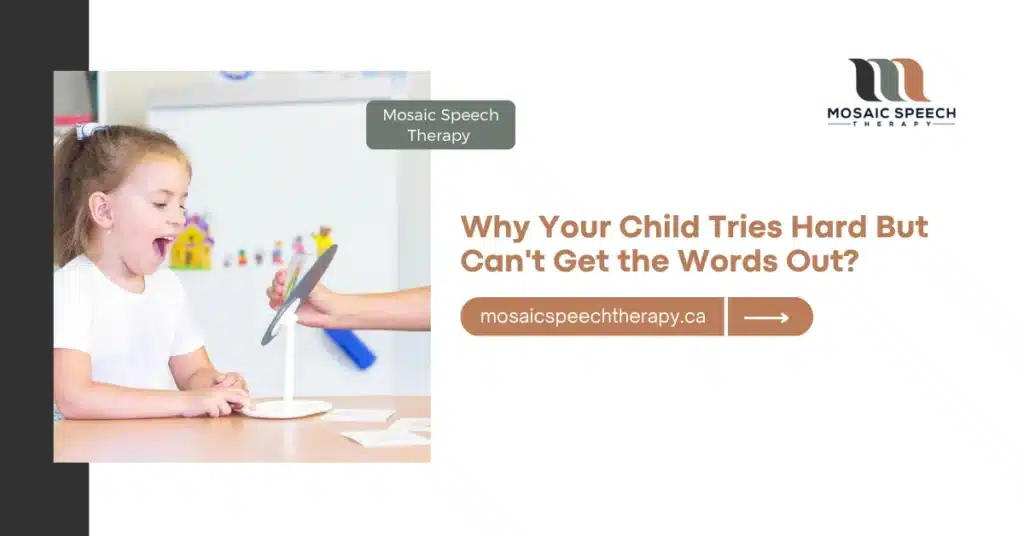
Your child clearly wants to talk. You can see the effort — the intent in their eyes, the way their mouth moves — but the words that come out are garbled, inconsistent, or barely recognizable.
Other people can’t understand them. Even you, their parent, have to guess much of the time. And yet your child doesn’t seem to lack intelligence or desire to communicate.
If this describes your experience, your child may have Childhood Apraxia of Speech (CAS) — a motor speech disorder that is often misunderstood and, when untreated, can significantly impact a child’s confidence, relationships, and academic development.
At Mosaic Speech Therapy in Edmonton, CAS is one of the most complex and rewarding challenges we support. Here’s what every parent needs to know.
What Is Childhood Apraxia of Speech?
Childhood Apraxia of Speech is a neurological motor speech disorder — not a muscle weakness and not a language disorder. The problem lies in the brain’s ability to plan and sequence the precise movements needed for speech. The child knows what they want to say. Their muscles are capable of moving. But the brain struggles to send the right signals in the right order to produce clear, consistent speech.
This is why CAS is so confusing for families: a child might say “spaghetti” clearly once, then struggle to say it again moments later. Speech errors in CAS tend to be inconsistent, which is one of the hallmarks that distinguishes it from other speech disorders like articulation disorders or phonological disorders.
Key Signs of Childhood Apraxia of Speech
CAS can be difficult to diagnose, especially in very young children. A comprehensive evaluation by a registered SLP is essential. Common signs include:
- Inconsistent speech errors: The same word is produced differently each time, rather than with a consistent pattern of errors
- Difficulty with longer or more complex words: Single-syllable words may be clearer than multisyllabic words; speech deteriorates with length
- Groping movements: Visible searching of the lips, tongue, or jaw before attempting sounds
- Limited babbling or variety of sounds in infancy: Many children with CAS had restricted babbling as babies
- Better comprehension than expression: The child understands far more than they can produce
- Prosody differences: Speech may sound robotic, with unusual stress patterns or rhythm
- Difficulty imitating sounds or words on demand, even when they have produced them spontaneously before
CAS often co-occurs with language delays, sensory processing differences, and other developmental concerns, which is why a thorough assessment matters.
What Causes Childhood Apraxia of Speech?
In many cases, no single cause is identified — this is called idiopathic CAS. In other cases, CAS is associated with:
- Known neurological conditions (e.g., epilepsy, cerebral palsy)
- Genetic syndromes (e.g., Down syndrome, Galactosemia, FOXP2 gene mutations)
- Brain injury or stroke
- Neurodevelopmental conditions like autism spectrum disorder
Understanding the underlying cause guides treatment planning, which is why our SLPs at Mosaic Speech Therapy conduct comprehensive assessments before developing any intervention plan.
Evidence-Based Treatment Approaches for CAS
CAS requires a specific type of speech therapy — not all approaches designed for other speech disorders are appropriate or effective. Treatment for CAS is typically:
Frequent and intensive. Children with CAS need many repetitions of targeted speech movements in every session. Research supports sessions 3–5 times per week during intensive phases of treatment, something our Edmonton families can access through our flexible scheduling.
Motor-based. Therapy focuses on the motor planning and sequencing of speech movements, using approaches such as Dynamic Temporal and Tactile Cueing (DTTC), Nuffield Dyspraxia Programme (NDP3), and Rapid Syllable Transition Treatment (ReST), depending on the child’s profile and age.
Hierarchical. Therapy progresses systematically from isolated sounds to syllables to words to phrases to spontaneous conversation, with careful attention to maintaining accuracy at each level before increasing complexity.
Paired with functional communication supports. While speech is being developed, children with CAS benefit from augmentative and alternative communication (AAC) tools — not as a replacement for speech, but as a bridge that reduces frustration and keeps communication flowing.
What You Can Do at Home Between Sessions
Practice little and often. Short, frequent home practice (5–10 minutes, 2–3 times per day) is far more effective than one long session. Consistency builds the motor pathways CAS disrupts.
Focus on accuracy, not speed. Encourage your child to say target words slowly and carefully, rather than rushing through them. Praise effort and clarity, not just intelligibility.
Keep a “word bank.” Work with your child’s SLP to identify 5–10 target words to practice at home. Using the same words your therapist is targeting in clinic accelerates motor learning through repetition.
Celebrate attempts. Children with CAS often become reluctant communicators because speaking is hard and frequently unsuccessful. Enthusiastically reward every communication attempt — the word doesn’t have to be perfect to be worth celebrating.
Don’t ask your child to repeat themselves multiple times. If you didn’t understand, respond to the gist of what you think they said or gently ask them to show you. Repeated failed attempts are discouraging and counterproductive.
Get Expert Assessment and Therapy in Edmonton

Childhood Apraxia of Speech is a diagnosis that requires a skilled, experienced SLP — and a treatment plan built specifically around your child’s motor speech profile. At Mosaic Speech Therapy, we specialize in motor speech disorders and work collaboratively with families at every stage of the journey.
We’re located at 205, 7609-109 Street NW in Edmonton, with daytime, evening, and weekend appointments available, direct insurance billing, and free street parking at our United Health Centre location.
If you suspect your child has CAS — or if they’ve been struggling with speech and you’re not sure why — please don’t wait. The earlier CAS is identified and treated, the better the outcomes. Contact us at info@mosaic-slp.ca or call 587-292-0072.