
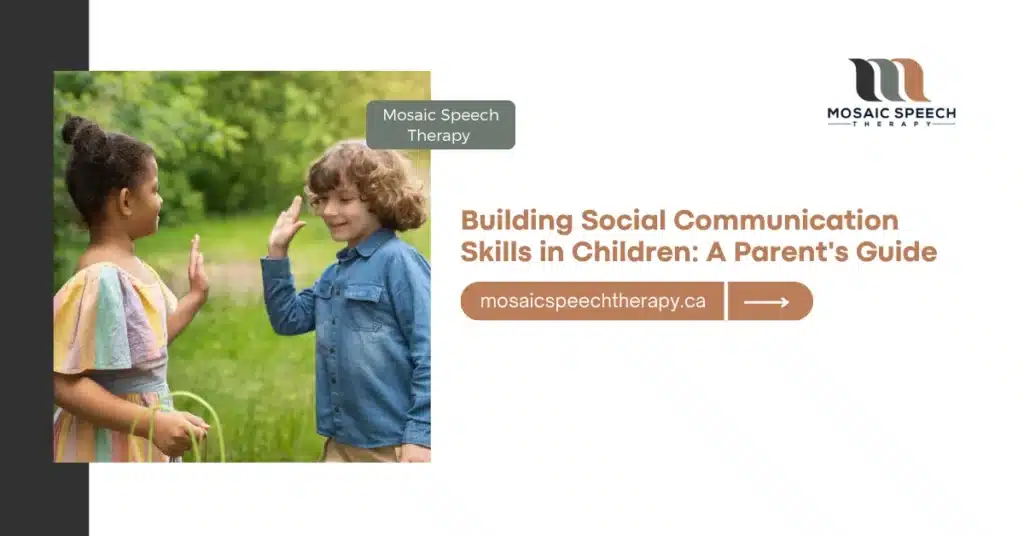
Your child is smart, funny, and full of personality at home. But at birthday parties, on the playground, or during group activities at school, something shifts. They hang back.
They interrupt at the wrong moments, say something that lands awkwardly, or simply don’t seem to know how to get into a conversation that’s already happening. Other kids move on, and your child is left on the outside — not because they don’t want to connect, but because they haven’t yet developed the invisible rulebook that social communication runs on.
This is more common than most parents realize, and it has a name: pragmatic language difficulty, sometimes also called a social communication disorder. It’s an area where speech-language pathologists can make a profound difference — and where parents play an equally important role every single day.
What Is Social Communication (Pragmatic Language)?
Pragmatic language is the social use of language — the unwritten rules that govern how we communicate in different contexts. It includes:
- Taking turns in conversation without interrupting or dominating
- Reading the room — adjusting how you talk based on the audience (differently with a teacher than a best friend)
- Understanding non-literal language like sarcasm, idioms (“it’s raining cats and dogs”), and jokes
- Staying on topic and transitioning smoothly between subjects
- Interpreting facial expressions, tone of voice, and body language as part of the message
- Initiating and maintaining conversations appropriately
- Repairing communication breakdowns when misunderstandings occur
These skills develop gradually throughout childhood, but for some children — including many with autism spectrum disorder, ADHD, language disorders, or no formal diagnosis at all — pragmatic language development lags significantly behind their peers.
What Social Communication Difficulties Look Like at Different Ages
Preschool (3–5 years): Limited pretend play with peers, difficulty taking turns in games, tendency to play alongside rather than with other children, trouble understanding that other people have different thoughts and feelings.
Early school age (6–9 years): Struggles to enter ongoing group play, dominates conversations with one topic, literal interpretation of figurative language (“I almost died laughing” — “Wait, you almost died?”), difficulty knowing when to stop talking.
Tweens and teens (10+): Challenges navigating the complexity of peer relationships, difficulty with banter and teasing distinctions, struggles in group projects or collaborative settings, social anxiety developing as awareness of differences grows.
Practical Strategies to Build Social Communication at Home

Play games that require reading others. Board games, card games, and even simple charades or “guess the emotion” activities naturally build the skills children need: taking turns, managing winning and losing graciously, reading facial cues, and negotiating.
Watch and pause TV or videos together. Pause a familiar show and ask: “Why did she look upset when he said that?” or “What do you think he’s going to say next?” This builds the habit of reading social and emotional cues — something children with pragmatic difficulties need explicit practice with.
Role-play real social scenarios. Practice specific situations your child finds challenging — entering a group, saying sorry, asking to borrow something, or disagreeing politely. Keep it light and playful, with you taking turns playing different roles. Predictability in practice builds confidence in the moment.
Narrate the social world. In everyday life, provide running commentary on social situations in a curious, non-critical way: “Did you notice that when you walked up, she turned to include you in the circle? That was her way of saying ‘come join us.'” This makes implicit rules explicit.
Debrief social experiences without blame. After a difficult social moment, revisit it calmly later: “That was a tricky situation. What do you think happened? What might you try differently next time?” Avoid shame-based conversations — the goal is curiosity and problem-solving, not correction.
Build on your child’s interests. Children engage most readily with peers who share their passions. Extracurricular activities — robotics clubs, art classes, drama programs — bring children together around shared interests, which naturally lowers the social pressure and provides structured interaction.
When to Seek Professional Support in Edmonton
If your child’s social difficulties are affecting their friendships, self-esteem, or enjoyment of school, a speech-language pathology assessment is a valuable next step. Our SLPs at Mosaic Speech Therapy assess pragmatic language as part of a comprehensive communication evaluation and develop individualized goals targeting the specific social skills your child finds most challenging.
We also offer group therapy sessions, which provide a structured, supportive environment where children can practice real social interactions with peers — one of the most effective formats for building pragmatic skills.
Reach us at info@mosaic-slp.ca or call 587-292-0072.