
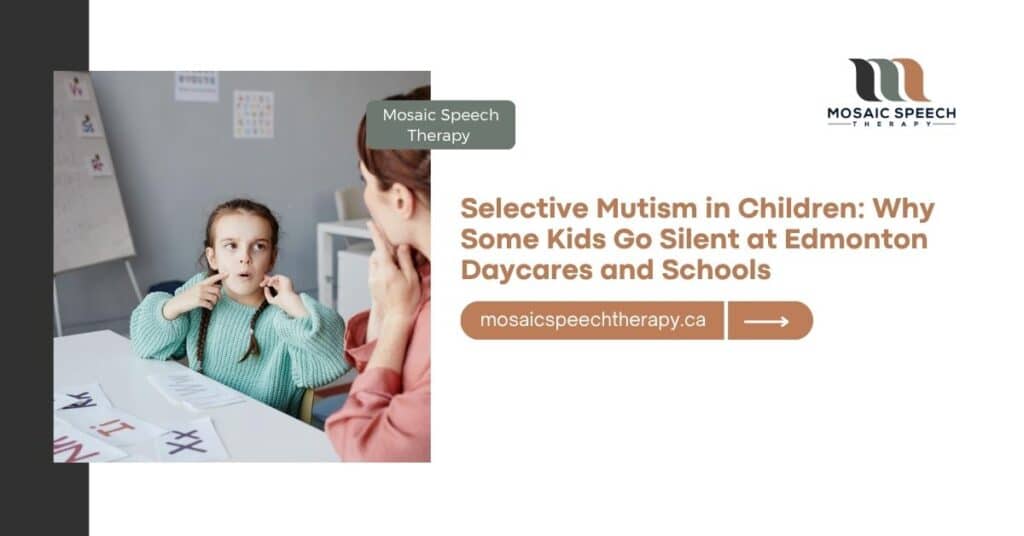
At home, your child is chatty, funny, and full of opinions. They negotiate bedtime, narrate their pretend play in elaborate detail, and never seem to run out of things to say. But when you drop them off at daycare, or when their Edmonton kindergarten teacher gives an update at pickup, the picture is completely different: your child doesn’t speak. Not to the teacher, not to classmates, sometimes not even to respond to their own name being called.
It’s confusing and worrying for parents, especially when well-meaning relatives or even educators suggest your child is simply “shy” or “will grow out of it.” For some children, this pattern is something more specific: selective mutism, an anxiety-based condition that prevents children from speaking in certain social settings despite speaking comfortably in others.
What Is Selective Mutism?
Selective mutism is classified as an anxiety disorder, not a speech or language disorder, voluntary defiance, or a result of trauma in most cases (though it’s important to rule out other explanations during assessment). Children with selective mutism have the ability to speak and typically have normal speech and language skills — but their anxiety response in specific social situations is severe enough to override their ability to verbally speak to others.
The hallmark pattern is consistent: comfortable, fluent speech in familiar, low-pressure environments (usually home, with immediate family) and a complete or near-complete inability to speak in other settings, most commonly school, daycare, or with unfamiliar adults and peers.
This is not a phase most children “snap out of” without support — research shows that without intervention, selective mutism often persists for years and can evolve into broader social anxiety in adolescence and adulthood.
Signs of Selective Mutism in Daycare and School Settings
Edmonton parents and educators may notice:
- Complete silence in the classroom or daycare, even when directly addressed by a familiar teacher after months of attendance
- Communicating through gestures, nodding, pointing, or writing instead of speaking
- Whispering only to a small number of trusted peers, if anyone at all
- Visible physical signs of anxiety before or during the school day — stomachaches, clinginess, tearfulness, or resistance to attending
- A stark contrast between behavior reported by teachers versus behavior at home, which can initially seem hard for parents to reconcile
- Freezing or appearing “stuck” when asked direct questions in social settings
It’s important to distinguish selective mutism from typical shyness. Shy children are usually willing to speak, just more slowly and with some hesitation in new situations. Children with selective mutism often appear physically unable to produce speech in the triggering environment, regardless of how much time passes or how comfortable the environment becomes for other children.
Why Early Intervention Matters
Selective mutism tends to become more entrenched the longer it goes unaddressed, as avoidance of speaking becomes a deeply reinforced coping pattern. A child who successfully avoids the anxiety of speaking in class for an entire school year has, in effect, practiced staying silent for an entire school year.
This is why early identification — ideally during the preschool or early elementary years common across Edmonton daycares and schools — leads to significantly better outcomes than waiting until a child reaches the upper grades.
How Speech-Language Pathologists Support Children with Selective Mutism
While selective mutism is rooted in anxiety, speech-language pathologists play an important role on the treatment team, often working alongside psychologists or counselors. Therapy typically includes:
Stimulus fading: A gradual, carefully sequenced technique where a trusted speaking partner (often a parent) is slowly introduced into the anxiety-provoking environment alongside the child, with verbal interaction gradually shifted toward new people and settings in small, manageable steps.
Building a hierarchy of speaking situations: Identifying specific, ranked goals from easiest to hardest (e.g., whispering one word to a familiar friend, then to a new peer, then to a teacher) and celebrating progress at each level.
Collaborating with Edmonton schools and daycares: SLPs often work directly with educators to create supportive classroom environments that reduce pressure to speak on demand while still encouraging gradual progress — including strategies like allowing non-verbal participation options and avoiding singling the child out.
Parent and caregiver coaching: Teaching families how to support exposure-based progress at home without inadvertently reinforcing avoidance (for example, by always speaking on the child’s behalf in public).
What Edmonton Parents Can Do
Avoid pressuring your child to speak. Comments like “just say hi” or “use your words” tend to increase anxiety rather than resolve it. Instead, model relaxed, low-pressure social interactions yourself.
Praise brave behavior, not just speech. Celebrate small steps — making eye contact, nodding, or staying in a social situation a little longer than before — even if no words were spoken.
Communicate with your child’s teacher or daycare educator. Let them know what’s happening and collaborate on a consistent, low-pressure approach across settings.
Don’t speak for your child reflexively. While it’s tempting to jump in and answer for your child in social situations, this can unintentionally reinforce the pattern. Pause, and give gentle opportunities for your child to respond in their own way and time.
Get Support for Selective Mutism in Edmonton

If your child stays silent at daycare, school, or in other social settings despite chatting freely at home, you don’t have to navigate this alone — and earlier support leads to better outcomes. At Mosaic Speech Therapy, we assess and support children with selective mutism, often in collaboration with psychologists, school staff, and families, to build a coordinated path forward.
If you’re ready to start the search for the right speech therapist for your child, we’d love to talk with you. Reach us at info@mosaic-slp.ca or call 587-292-0072.