
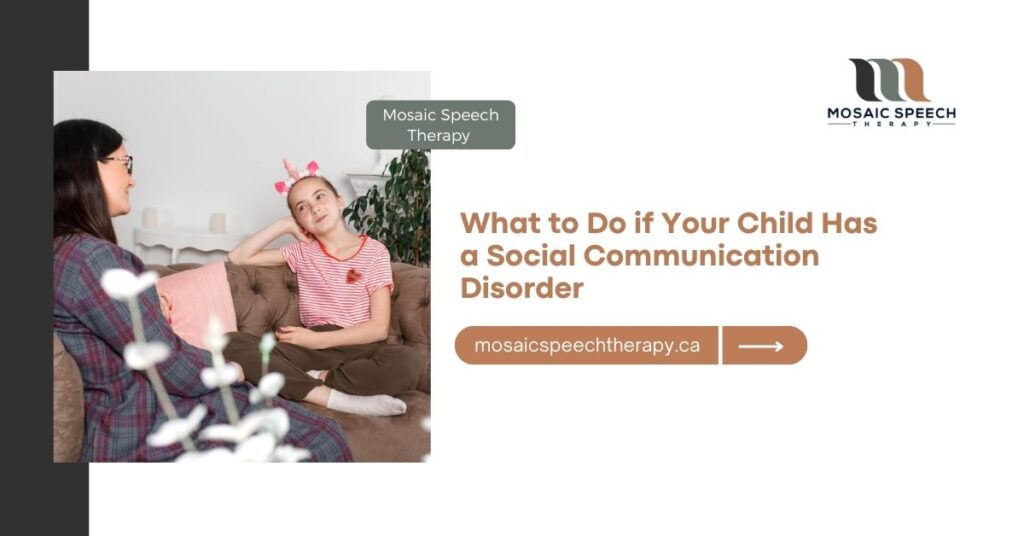
Recognizing that your child may be struggling with a social communication disorder can be a moment filled with concern and uncertainty.
These challenges, which impact a child’s ability to use verbal and non-verbal language appropriately in social contexts, are nuanced and deeply affect how they connect with the world.
At Mosaic Speech Therapy in Edmonton, we understand that taking the first step toward support is paramount. This guide provides a detailed, actionable pathway for parents and caregivers in the Edmonton area to navigate this journey with confidence and clarity.
Understanding Social Communication Disorder: Recognizing the Signs

Social Communication Disorder (SCD) is characterized by persistent difficulties in the social use of verbal and nonverbal communication. This is distinct from general language delays and often coexists with other conditions. Key signs may include:
- Pragmatic Language Challenges: Difficulty following rules for conversation and storytelling, such as taking turns in conversation, rephrasing when misunderstood, and knowing how to use verbal and nonverbal signals to regulate interaction.
- Social Reciprocity Deficits: Challenges in engaging in age-appropriate social relationships, sharing interests and emotions, or responding to the emotional cues of others.
- Non-Verbal Communication Difficulties: Impaired understanding and use of gestures, eye contact, facial expressions, and understanding personal space.
- Adaptation Issues: Difficulty adjusting communication style to match the context or the needs of the listener, such as speaking differently on a playground than in a classroom.
Early identification of these patterns is important. A child with Social Communication differences may be motivated to connect with peers, but may communicate in ways that differ from neurotypical expectations.
Without appropriate supports, this mismatch can contribute to frustration, reduced participation in social interactions, and challenges in academic environments.
Immediate Steps for Parents and Caregivers in Edmonton
Upon observing consistent signs of a social communication disorder, a structured approach is essential. We recommend the following initial actions:
1. Document Your Observations Systematically
Begin by keeping a detailed log of specific instances that cause concern. Note the context, who was involved, what the communication breakdown entailed, and the outcome.
This record becomes an invaluable tool for professionals during assessment. Focus on concrete examples, such as, “During playdate, did not respond to peer’s question about toy preference and turned away,” rather than general statements.
2. Initiate a Collaborative Dialogue with Key Figures
Schedule meetings with your child’s teacher, daycare supervisor, or other caregivers to gather a holistic view of your child’s communication across different environments. Inquire about their observations in group settings, during unstructured play, and in one-on-one interactions.
This collaborative perspective helps distinguish between context-specific behaviors and a consistent pattern indicative of SCD.
3. Seek a Comprehensive Professional Assessment
A formal diagnosis is the cornerstone of an effective intervention plan. In Edmonton, the pathway typically involves consulting with your family physician or pediatrician to rule out any medical contributing factors and obtain a referral to a registered psychologist for a developmental assessment.
Concurrently, a referral to a certified Speech-Language Pathologist (SLP) is crucial for a specialized evaluation of pragmatic language skills.
As a leading clinic in Edmonton, Mosaic Speech Therapy provides in-depth assessments that analyze the nuanced components of social communication within our dedicated therapy spaces.
The Professional Assessment and Diagnosis Pathway
The assessment process for Social Communication Disorder is multi-faceted. A qualified SLP will employ a combination of standardized testing, parent/teacher interviews, and direct observation of your child in interactive situations. The assessment will evaluate:
- Social Interaction: Ability to greet, request, comment, and share.
- Social Understanding: Comprehension of inferred meaning, sarcasm, humor, and figurative language.
- Discourse Skills: Ability to maintain a topic, tell a coherent story, and repair conversations when misunderstandings occur.
- Non-Verbal Communication: Interpretation and use of body language, proximity, and tone of voice.
This detailed profile allows us to differentiate SCD from other conditions like Autism Spectrum Disorder (where restricted/repetitive behaviors are also present), Attention-Deficit/Hyperactivity Disorder, or anxiety disorders. A clear diagnosis paves the way for a targeted, individualized therapy plan.
Building an Effective Intervention Plan with Speech Therapy

Effective intervention for Social Communication Disorder is rooted in evidence-based practice and family-centered care. At Mosaic Speech Therapy in Edmonton, our intervention strategies are tailored and dynamic.
1. Individualized Therapy Sessions
Therapy often involves direct, one-on-one sessions where our SLPs use structured activities and play-based therapy to teach specific skills in a safe environment. We may utilize techniques like:
- Scripting and Role-Playing: Practicing predictable social routines and scenarios to build confidence and competence.
- Video Modeling: Using recorded examples to teach and review appropriate social behaviors and responses.
- Visual Supports: Creating social stories, comic strip conversations, and cue cards to break down abstract social concepts.
2. Peer-Mediated and Group Therapy Interventions
Generalizing skills to real-world settings is a primary goal. We facilitate small, structured group therapy sessions with peers to provide a controlled yet authentic social laboratory.
Here, children practice conversation, cooperative play, problem-solving, and friendship skills under the guided support of our therapists.
3. Empowering the Home and School Environment
Therapy extends beyond the clinic. We actively collaborate with parents and educators, providing coaching and strategies to reinforce social communication goals throughout the child’s day.
This may involve creating consistent communication expectations at home, working with schools to implement supportive accommodations, and training key adults on how to model and scaffold social interactions effectively.
Navigating a social communication disorder is a journey, but it is one you do not have to walk alone. With proactive assessment, targeted intervention from skilled professionals, and a supportive network, children can develop the skills they need to build meaningful connections and thrive.
Our team at Mosaic Speech Therapy in Edmonton is committed to providing the expert, compassionate guidance necessary to help each child find their voice and place within the social world.
For personalized assistance, feel free to contact us at info@mosaic-slp.ca or 587-292-0072.